Wednesday, August 27, 2014

Strategies for a Successful School Year...

Here are some tips from the Gurian Institute for making it a great day - every day:

Sleep - Processing information and releasing toxins during sleep allows us to be attentive learners the next day. How much? TEN hours of sleep for elementary aged students, in bed no later than 8:30.

Eat Breakfast - Protein for breakfast allows energy to burn slowly and keeps hunger pains away. What kinds? Eggs, meat, peanut butter, yogurt.

Eat Together - A great opportunity to stay connected (teens consistently say this is an important time for them) and to discuss events, offer opinions, and "argue" - all ways for teens to discern who they are and what they value.

Read, Read, Read - Read with your children everyday, model good reading habits, explain to them when you read and why you read - recipes, maps, etc. 

 For more, visit the Gurian Institute More 

Thursday, August 21, 2014

How Google's Larry Page became a responsible entrepreneur

The business world is taking a closer look at the benefits of the Montessori model in the workplace. This recent blog by business consultant, Carol Sanford, looks at the early-life influences of Google founder, Larry Page. She credits a big part of his company's success to the business model that he built from the Montessori classroom structure of his youth. She writes:
"An unconventional education was a second significant influence in Page’s life. Like his Google co-founder, Sergey Brin, Page attended Montessori schools until he entered high school. They both cite the educational method of Maria Montessori as the major influence in how they designed Google’s work systems.The Montessori Method believes that it has a “duty to undertake, in the school of the future, to revolutionize the individual.” Montessori’s ultimate goal of education was to create individuals who could improve society and were unafraid to take on seemingly impossible tasks. In fact, Montessori spoke at length about education for peace. “Everything that concerns education assumes today an importance of a general kind, and must represent a protection and a practical aid to the development of man; that is to say, it must aim at improving the individual in order to improve society”
Maria Montessori believed that the liberty of the child was of utmost importance. For her it was imperative that the school allow a child’s activities to freely develop. Without this freedom, children could not grow the personal agency that would allow them to serve a social purpose as adults. Thus, Page’s childhood education promoted independence. It encouraged students to grow at their own rate. They were allowed large chunks of uninterrupted time to work on projects they created themselves. Students were encouraged to take on small-scale but real-world challenges and to invent ways to solve them.
It’s easy to see how Google’s well-known policy of encouraging all engineers to dedicate 20% of work time to projects of personal interest grew directly out of this educational history. And why collaboration without supervision is core to Google’s work culture. And why Page repeatedly exhorts his colleagues to generate “10x returns” with regard to the social benefits they are striving to create. He is recreating the inspiring learning environment he had as a child, where the focus was on growing free people with the capacity to transform society."

If you would like to read Sanford's blog in its entirety, it can be found at: http://www.theguardian.com/sustainable-business/2014/jul/23/entrepreneur-larry-page-google-innovation-change?CMP=twt_gu

Wednesday, August 13, 2014

Five Ways to Raise Kind Children

A recent Harvard study asked children about what their parents valued most in them. The results showed that 75% of those children felt that getting good grades was more important than being a caring community member. As a result of this and similar studies, Harvard has created the Making Caring Common Project to teach and encourage the teaching of moral education to children. They have come up with five ways to raise a kind child, which includes easy things to try at home to encourage thought about the needs and feelings of others.


And if you would like more information about the study or the Making Caring Common Project, here is a link to their website as well: http://www.gse.harvard.edu/news-impact/tag/making-caring-common-project/


Thursday, August 7, 2014

Anne Frank's Montessori School

How interesting! Did you know that the Montessori school Anne Frank attended from 1934-1941 is still teaching children today? Read about one teacher's visit to the school in Amsterdam.

http://inspireacademies.edublogs.org/2013/01/31/annes-montessori-school/


Wednesday, July 30, 2014

Why Do Americans Stink at Math?

“The new math of the ’60s, the new, new math of the ’80s and today’s Common Core math all stem from the idea that the traditional way of teaching math simply does not work”

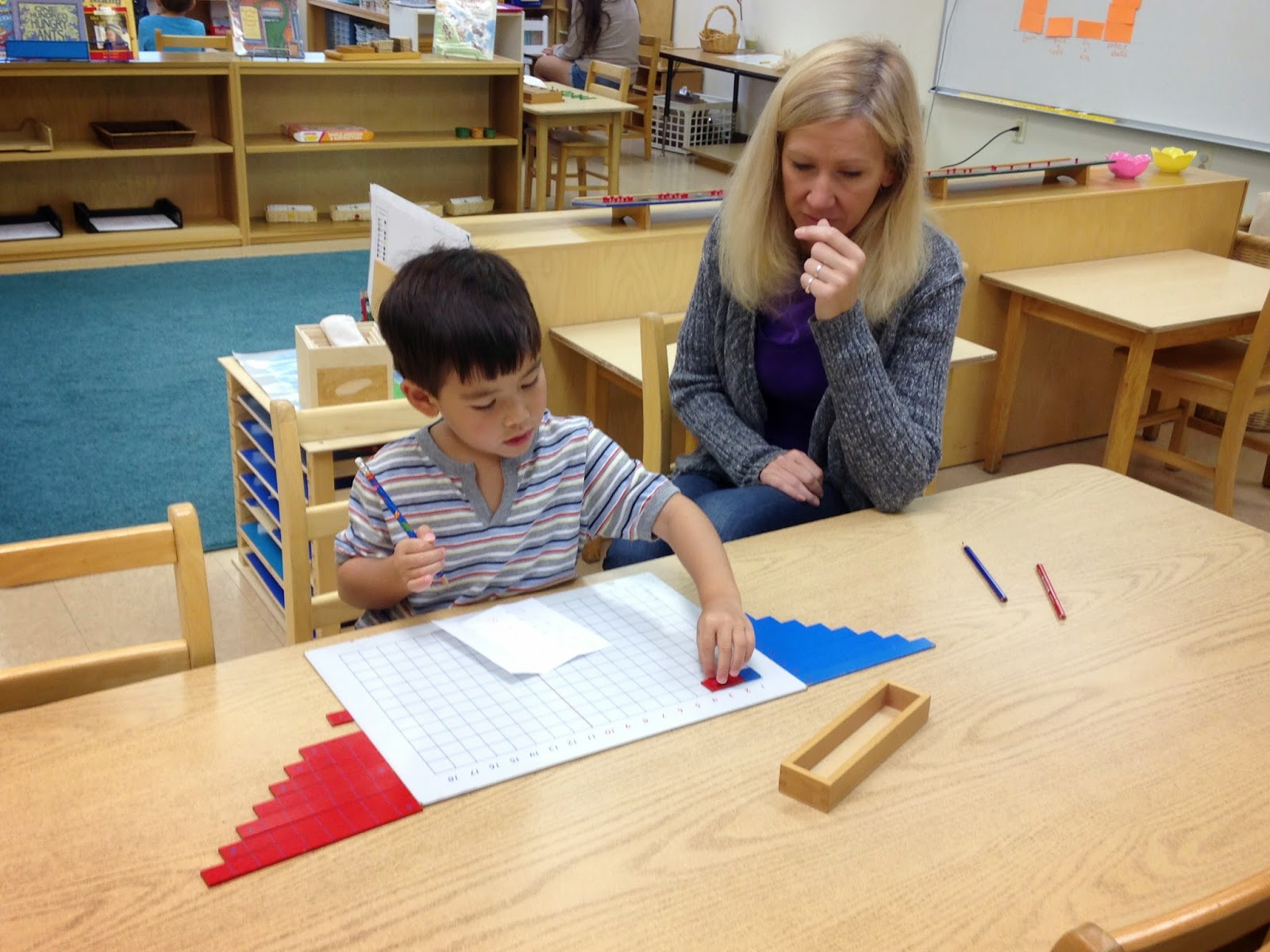
A must read article in the New York Times this past weekend.  All the more reason every child deserves a Montessori math education, click here for the link to the entire article.


Tuesday, July 22, 2014

8 Ways to Teach Compassion to Kids

The following article by Signe Whitson was recently posted on the Huffington Post. Signe Whitson is a school counselor, author, and national speaker on topics related to stopping bullying and promoting children's mental health.

8 Ways to Teach Compassion to Kids

1. Walk the Talk
Children may listen to your words, but more importantly, they learn from observing your actions. When you have a chance to practice a random act of compassion, do so! When you are frustrated in an interpersonal interaction, express your displeasure in words that show respect for the dignity of the person you are addressing. When you encounter a person who needs help, stop what you are doing and tend to them, even (read: especially!) if it is not particularly convenient to do so. Remember: opportunities to show compassion do not occur by appointment. Show young people that anytime is the right time to engage in acts of service and compassion for others.


2. Put the Child on the Receiving End of Compassion
While showing compassion to others is a top way to teach this value to a child, allowing a young person to experience compassion first-hand is even more impactful. When your child is hurt or sick, be sure to provide abundant TLCC (tender, loving, compassionate care.) It may sound obvious, but tending to a child when he is feeling down or under the weather is the best way to teach him how to show compassion to others.


3. Talk the Talk
Most children can learn about true compassion by seeing and feeling this trait acted out, but when parents talk explicitly about acts of compassion, they communicate its importance as a prized family value. As you watch television or movies with your child, be sure to point out instances where compassion was shown -- or should have been shown! Talk about people who particularly need compassion, such as the elderly and children living in poverty.


4. Volunteer Your Time
When children become actively involved in acts of showing compassion to others, they learn about this value in a very deep and enduring way. Find age-appropriate ways to introduce your child to volunteering, such as visiting a nursing home and sharing a craft activity with a resident, serving a meal at a homeless shelter, helping to organize a canned food drive, collecting coats to donate to needy children, or even participating in a charity walk for a specific cause. These activities are at once meaningful and fun, which makes them especially effective in getting kids to routinely think compassionately about the needs of others.


5. Care for a Pet
Bringing a pet into a family is certainly not a step to be taken lightly or impulsively, but it is worth giving serious consideration to providing your young person with the experience of caring for an animal, as a way to foster compassion. Children who care for pets learn important values such as responsibility, unconditional love, empathy, and compassion for all living things.


6. Read All About It
Children's books are great for providing a window into the experiences of others. As a School Counselor, my go-to children's writer is Trudy Ludwig, the award-winning author of such books as
My Secret Bully (my all-time favorite pick for sparking conversations with kids about bullying and relational aggression) and The Invisible Boy, a great read for inspiring empathy and compassion for young people who find themselves on the periphery of school social hierarchies. For older kids, check out biographies of famous figureheads of compassion, such as the Dalai Lama or Mother Theresa.

7. Compassion It™
In recent years, rubber wristbands have become a ubiquitous symbol of causes and concerns. While most of the messages are positive and inspiring, I must admit that their sheer common-ness resulted in me stopping reading the various messages on friends' wrists. Until recently. I noticed a two-tone band that a relative was turning over and felt compelled to ask about it. It was a
Compassion It band, she explained. Every morning, she puts the band on her wrist with its black side facing outward, as a personal reminder to act compassionately toward someone else. When such an act is committed each day, she turns the bracelet to its white side.
What a great idea -- so simple, yet such a powerful reminder to prioritize kindness and make compassion a part of her everyday routine. Needless to say, I went online and bought a band for myself and one for each of my daughters right away. Does this turn compassion into a chore, you may ask. Am I making kindness into a To-Do list item for my kids, you wonder. Nope, not at all, I say with confidence. Quite the contrary: the bands have turned compassion into an everyday topic of conversation in our household and has effectively elevated kindness into a priority in each of our days. Best. Bracelet. Ever.

8. Make a Wish
Acts of life-changing compassion can be only a click away. Use the internet to introduce your child to different charitable organizations that provide compassionate assistance to others. The Make-a-Wish Foundation provides hope, strength, and joy to children with life-threatening medical conditions. While for younger kids, the site may be too heart-wrenching or scary, older kids can have a truly impactful experience of being able to provide tangible help and joy to a peer. The experience can be life-changing for both giver and receiver.


For additional information and articles, please visit www.signewhitson.com.

Thursday, July 17, 2014

Library Visits

 “People may go to the library looking mainly for information, but they find each other there.” Robert Putman

As I saunter through the many myriad of books at my local library, I cannot help but gravitate to the children’s section with all the colorful hardcover books, the whimsical art displayed on the walls, little ones sitting on their parent’s lap intently reading books, etc.

With children almost fully grown, I often wonder why I am so drawn to this section of the library.  As I reflect a bit more, I realize this special place was a place where my children and I grew up together, discovered fun filled books,  met life-long friends, shared story time, etc. - we found each other and we found our second home. 

Should you be near a library today, visit and discover a community outside of yourself.